
Learn it firsthand, safely.
VR training that answers back.
Interactive VR and mixed-reality simulation where the patient reacts to every decision. For nursing, hospitals, first aid, mining, defence and EV trades, with regional packs for Australia, the USA and Asia.
Compatible with Meta Quest, PICO, Samsung Galaxy XR, HTC VIVE, Apple Vision Pro and PC VR · 6DoF
- HR
- 128bpm
- SpO₂
- 89%
- RR
- 28/min
- NIBP
- 92/58mmHg
Live patient engine: these numbers move with what the trainee does.
See what trainees see
These are captures from the product, not concept art. Pick a moment from a scenario.

Practice mode puts hotspots on the patient. Listen to the chest and the finding appears where you are looking.

Close-look panels show what a real examination would reveal: pupils, skin, the trace on the monitor.

Room-scale and 6DoF, with hands or controllers. Coach mode shows where the pads go until you are ready to go without it.

Every run ends in a scored debrief: what you did, when, and what to work on next time.
One platform for the people who can’t practise on the real thing
All industriesImmersive learning for healthcare and high-risk work: immersive training where people act, see the consequence and get a scored debrief. Read more about VR training and VR in healthcare.
Nursing schools and universities
Virtual simulation that behaves like a ward, not a quiz.

Hospitals and health services
Patient simulator practice for education teams and sim labs.

First aid providers and RTOs
CPR simulator practice before the hands-on assessment.

Aged care and disability providers
Practice for care workers before the real shift.

Mining and industrial safety
Confined space, electrical rescue and fire, without the risk.

Defence and emergency services
Casualty care for combat medics and paramedics.

Automotive and EV trades
High-voltage safety before anyone touches a live system.
Training something else that is hard to rehearse?Custom scenarios and environments are scoped with you during a pilot. Talk to usPractise, run it for real, then debrief
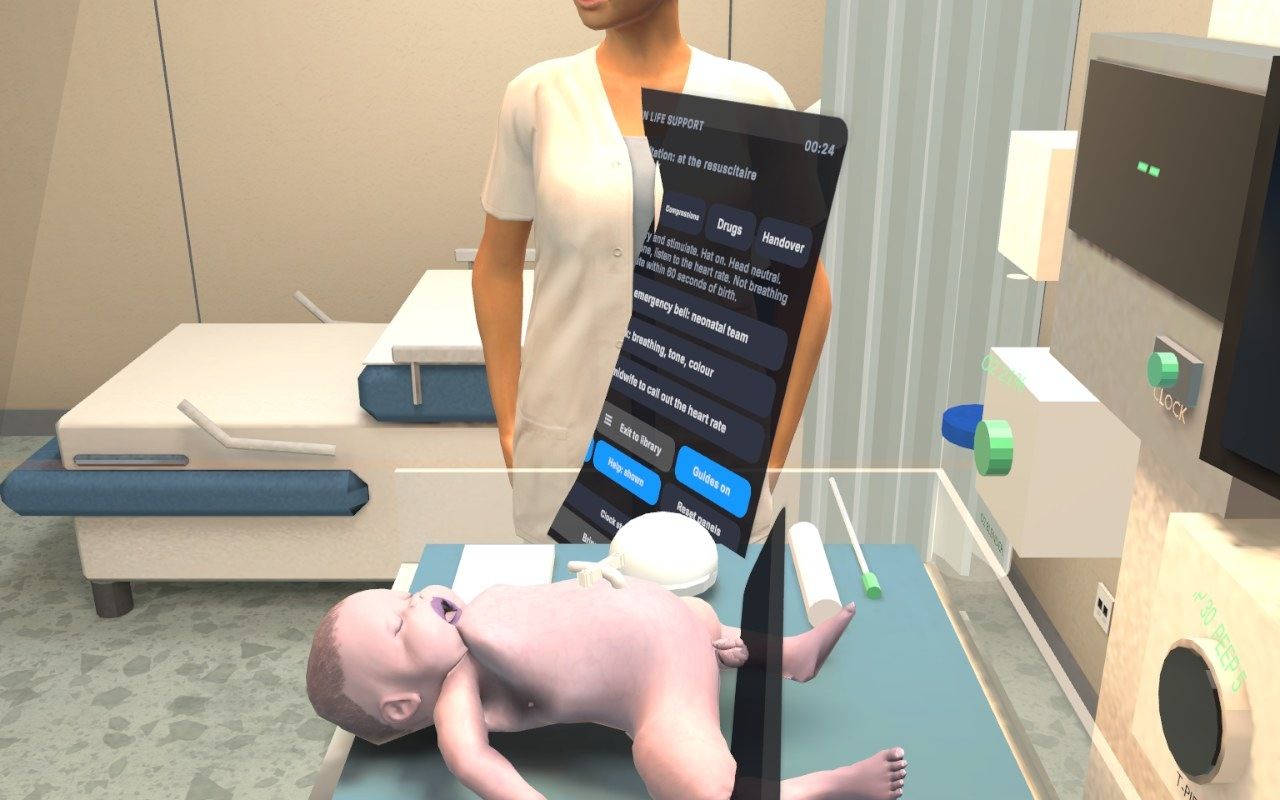
Practise with guides
A guide panel and hotspots walk trainees through each step so the routine becomes automatic.
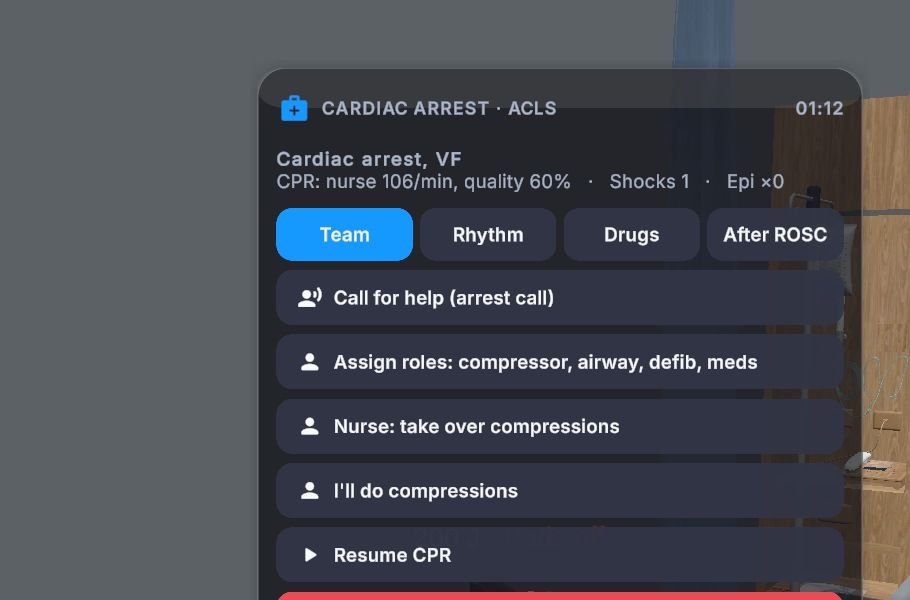
Run the scenario
Guides off. The patient engine reacts to every decision. Alone, or as a team with roles.
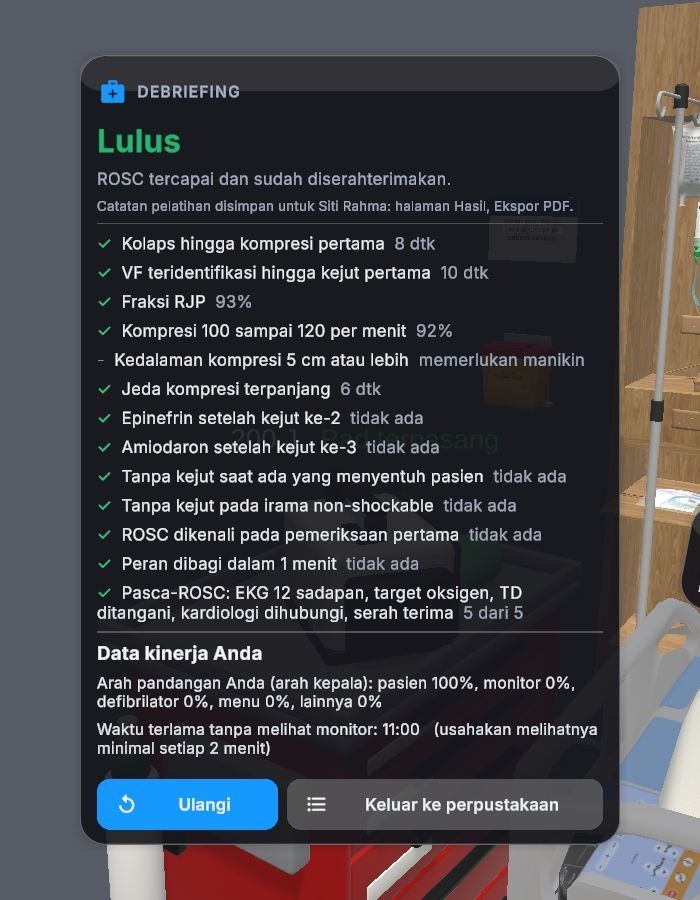
Debrief and go again
Timed, scored actions against ANZCOR or AHA guidance. Run it again straight away.


Built like a clinical environment, not a game level
Wall oxygen, suction, a monitor that shows the trace, beds that move. The equipment is where it would be, so habits carry over to the real room.


- Live patient engine
- Heart rate, oxygen saturation, breathing and blood pressure respond to what the trainee does, or does not do.
- Scoring and debrief
- Actions are timed and scored against the guideline, then explained in a debrief.
- Team sessions
- Headsets on the same network join one scenario with roles: compressions, airway, defib, drugs.
- Mixed reality
- Passthrough mode places the scenario in your real room, next to your real equipment.
- Regional packs
- Australia, USA and Indonesia/Asia: uniforms, drug names, units, emergency numbers, ANZCOR or AHA.
- English and Indonesian
- Full interface and scenario text in both languages, with more planned.
Compatible with the headsets you can actually buy
Room-scale and 6DoF on every device. Standalone on Meta Quest 3 and PICO, so there is no PC to set up for every session, with a passthrough mode when you want the real room in view. VR, AR or mixed reality?
Compatible with Meta Quest 3, PICO 4 Ultra Enterprise, PC VR and Microsoft HoloLens 2. Product names belong to their owners. We are not affiliated with or endorsed by them. Which headset should you choose?
- Illustration
Meta Quest 3
Standalone
- 6DoF
- Standalone
- Hand tracking
- Passthrough MR
- Controllers optional
Our recommended headset for new deployments: VR and mixed reality on one device.
Meta Quest 3 for training - Illustration
PICO 4 Ultra Enterprise
Standalone
- 6DoF
- Standalone
- Hand tracking
- Passthrough MR
- Controllers optional
A strong choice for new deployments, especially for sites standardised on PICO.
PICO 4 Ultra Enterprise for training - Illustration
PC VR
Tethered to a PC
- 6DoF
- Tethered
- Hand tracking, by model
- Controllers
Teams that already own PC VR headsets and a capable PC. Compatible with SteamVR headsets including Valve Index, Steam Frame, Varjo, Pimax and HTC VIVE Pro.
Standalone or tethered? - IllustrationSupported for existing fleets
Microsoft HoloLens 2
Standalone, see-through visor
- 6DoF
- Standalone
- Hand tracking
- Holographic AR
Firsthand began on HoloLens 2 and still supports organisations that own them. Microsoft has ended production, and security updates and support run to the end of 2027, so we recommend Meta Quest 3 or PICO for new deployments.
HoloLens 2 end of life
Also supported: Meta Quest 3S, PICO 4 Ultra, Samsung Galaxy XR, HTC VIVE Focus Vision, Apple Vision Pro, SteamVR headsets including Steam Frame, Magic Leap 2 (existing fleets). All headsets
What 6DoF means
Six degrees of freedom: the headset tracks how you turn your head and how you move through the room. That is what lets a trainee walk round the bed instead of watching from one spot.
VR training explainedConnects to your learning systems
LTI 1.3 for LMSs such as Canvas, Moodle, Blackboard and D2L Brightspace, xAPI to your learning record store, a SCORM package, and single sign-on with Microsoft Entra ID or Google. We set this up with your IT team during onboarding.
How it connectsLTI 1.3
Scores to the gradebook
xAPI
Step-by-step records
SCORM package
Hospital and corporate platforms
Single sign-on
Entra ID or Google

Realism you notice in the first five seconds
Near-photoreal rooms and equipment run on a standalone headset. Next up: MetaHuman-quality characters built for Meta Quest 3, so faces show pain, fear and relief.

Weighing up options?
Fair, sourced comparisons with the platforms people usually shortlist. We say where they are stronger, too.
All comparisons- Oxford Medical Simulation vs Firsthand XROMS says it runs on screen (PC, laptop, Mac) and in VR headsets, which makes access easy for large cohorts.
- UbiSim vs Firsthand XRUbiSim says it is dedicated exclusively to nursing education simulation.
- SimX vs Firsthand XRSimX says its nursing content includes over 150 simulations in up to 97 environments.
- Start Beyond vs Firsthand XRStart Beyond is based in Sydney with offices in Melbourne and Brisbane, and has worked with organisations such as St John Ambulance.
- GWPro vs Firsthand XRGWPro lists more than 20 courses including scaffolding, LOTO, hot work, arc flash and forklift hazards.
- VR vs manikinsWhen to use each, and why the best programs use both.
13 scenarios available, 8 on the way
Open the scenario librarySee it in a headset
Book a 30-minute demo. We will run a scenario live, talk through your training units and scope a pilot that fits your team.